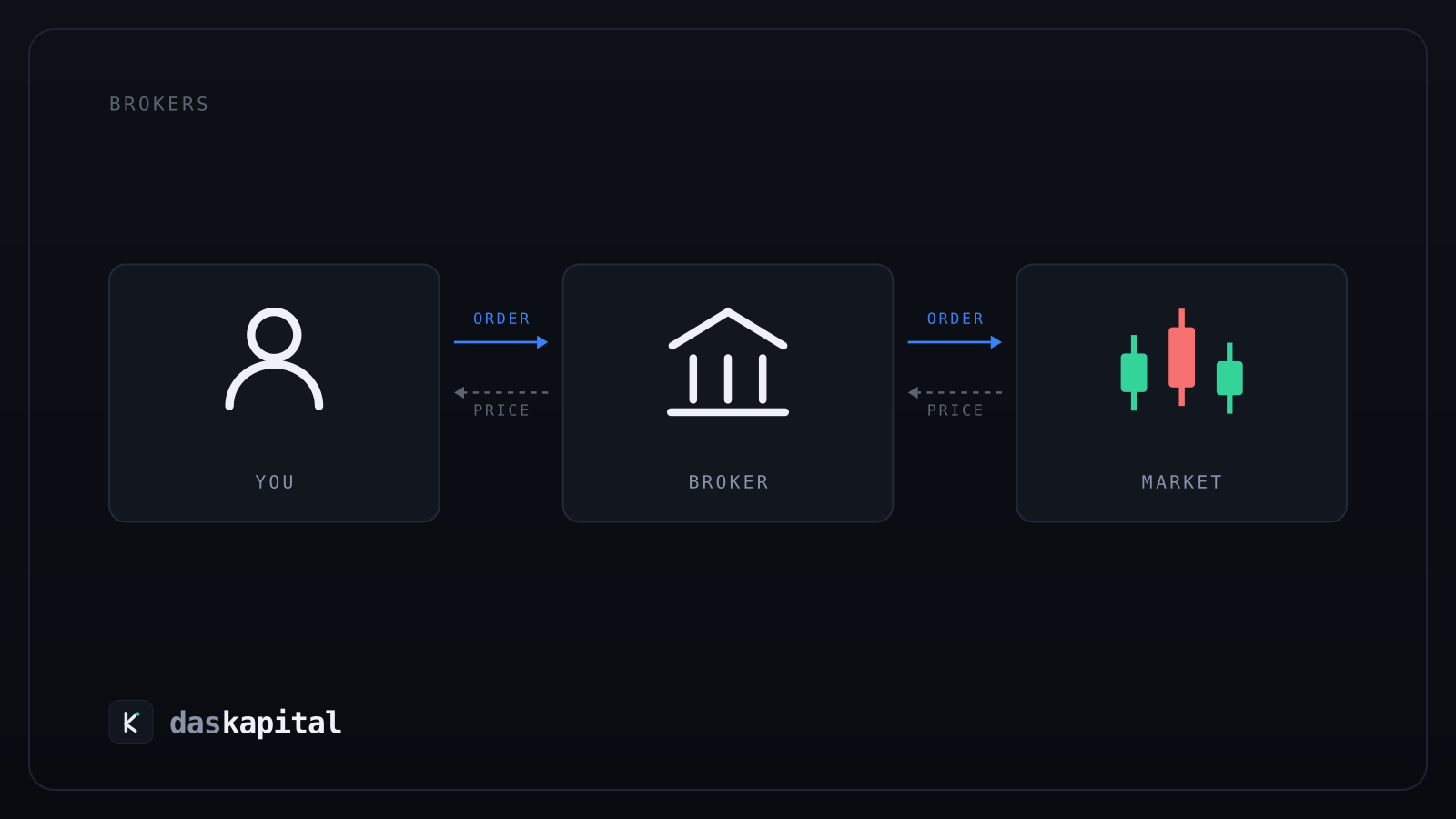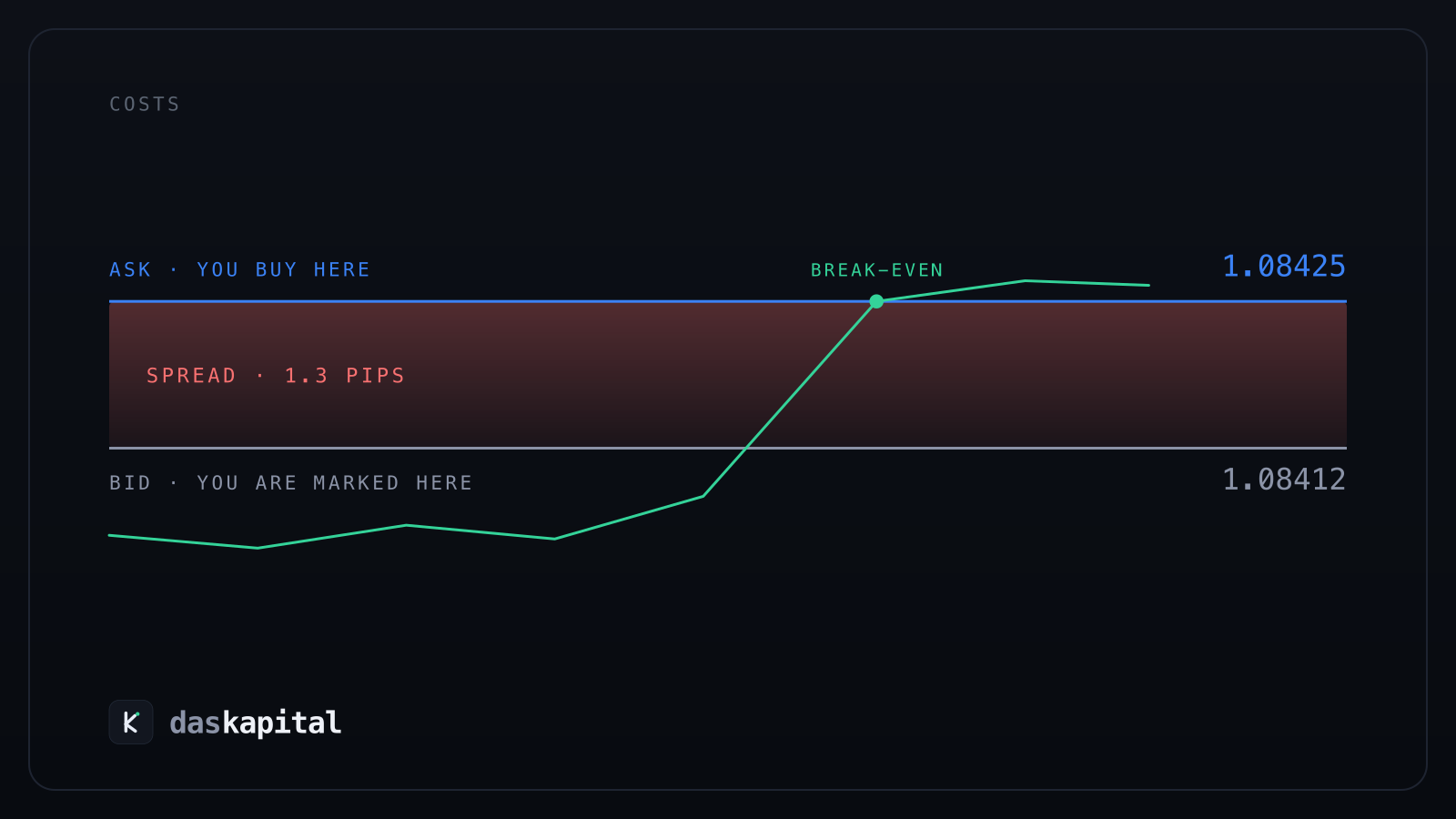
Every position opens at a loss. Not as a figure of speech: you buy at the ask and you are marked at the bid, so the instant a trade exists it is behind by the gap between them.
Bid, ask, and the gap between them
A broker quotes two prices for everything it offers. The bid is what you receive if you sell right now. The ask is what you pay if you buy right now. The ask is always the higher of the two, and the difference between them is the spread — the price of having somebody stand between you and the market.
Say EUR/USD is quoted 1.08412 / 1.08425. The spread is 0.00013, which on a five-decimal pair is 1.3 pips. Buy at 1.08425 and the position is immediately worth 1.08412, because 1.08412 is what somebody will actually pay you for it.
You cross it once, not twice
A common line — one this article used to carry — is that a move has to clear the spread twice. It does not, and the correction matters because it doubles the cost you think you are paying. Buy at the ask, sell at the bid, and if the market has not moved you are down one spread. Once.
The "twice" comes from measuring against the mid price, which is where charts and strategies usually live. Against the mid you pay half a spread entering and half a spread leaving. Two halves. One spread.
The same thing in money
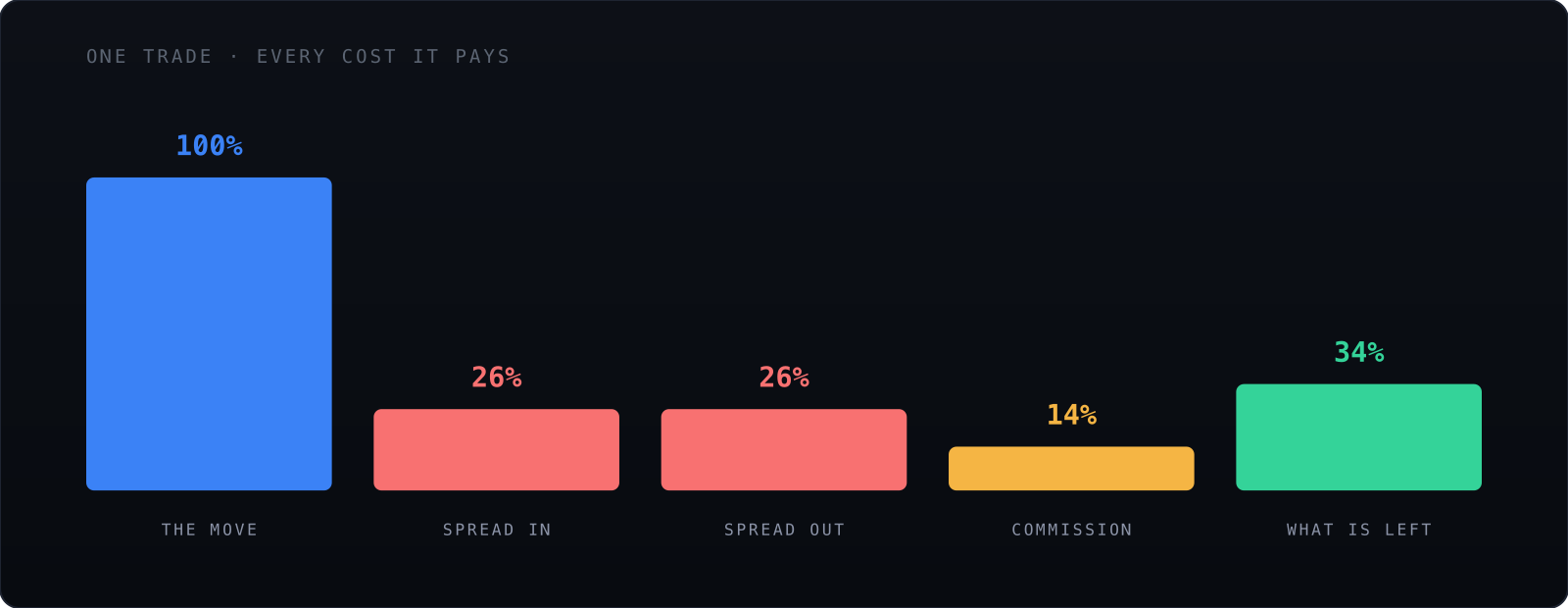
Pips are a unit that hides the size of the bet. On one standard lot of EUR/USD — 100,000 units — a pip is worth about $10, so the arithmetic becomes concrete:
| Cost | One standard lot of EUR/USD |
|---|---|
| Spread, 1.3 pips | $13.00 |
| Commission, round turn | $7.00 |
| Total, to open and close | $20.00 |
| Move needed just to break even | 2.0 pips |
So a five-pip move is worth $50 gross and $30 net. You keep 60% of what you were right about. Halve the position and every figure in that table halves with it; the two pips you need to break even do not move at all, because they are a property of the instrument and the account, not of your size.
Commission and financing are separate, and both are per lot
Commission is charged on volume, not on profit — typically a few dollars per lot per side on a raw-spread account, and folded into a wider spread on a commission-free one. Neither is cheaper by default; they are the same fee wearing different clothes, and which wins depends on the instrument.
Holding a position past the broker's daily rollover adds swap: the interest difference between the two currencies, credited or debited nightly, and usually charged at triple rate one day a week to cover the weekend. On a position held for minutes it is nothing. On one held for weeks it can exceed the spread many times over.
What makes a spread wider
- The hour. The same pair costs several times more to trade in the thin hours between the New York close and the Tokyo open than it does when London and New York overlap.
- News. Spreads widen around scheduled releases and can gap violently through them. The quote you saw is not a promise.
- The instrument. Majors are the cheap end. Exotic pairs, single shares and small indices are frequently ten times more expensive, measured against the move they typically make.
- The weekend. Instruments that trade continuously, crypto in particular, are widest exactly when the fewest people are looking.
- The account type. Raw-spread accounts quote tighter and bill commission separately; standard accounts bundle it. Compare the total, never one half of it.
How to read "from 0.0 pips"
That is a minimum, and a minimum is not a cost — it is the best tick of the best hour of the best day. What you want is the median on the instruments you actually trade, at the hours you actually trade them. The average is worse than useless here: it is dragged around by the few minutes surrounding a release, when nobody sensible is trading anyway.
The only number that settles the argument is the one from your own account: compare the fill price you got against the mid at the moment you sent the order, and do it over enough trades that one bad fill does not decide the answer.
What to do about it
- Price the round trip in money before the trade, not in pips after it.
- Compare brokers on spread plus commission plus swap, for the instruments on your list — not on the headline number for EUR/USD.
- Size the target against the cost. A strategy aiming at three pips on an instrument that costs two to trade is not a strategy.
- Stay out of the seconds around a scheduled release unless the release is the trade.
An edge smaller than the cost of taking it is a fact about the market, not a setting to tune.
We compare what the brokers we connect to actually charge on the broker comparison page, and the costs differ by instrument as much as by broker — which is the subject of what there is to trade.