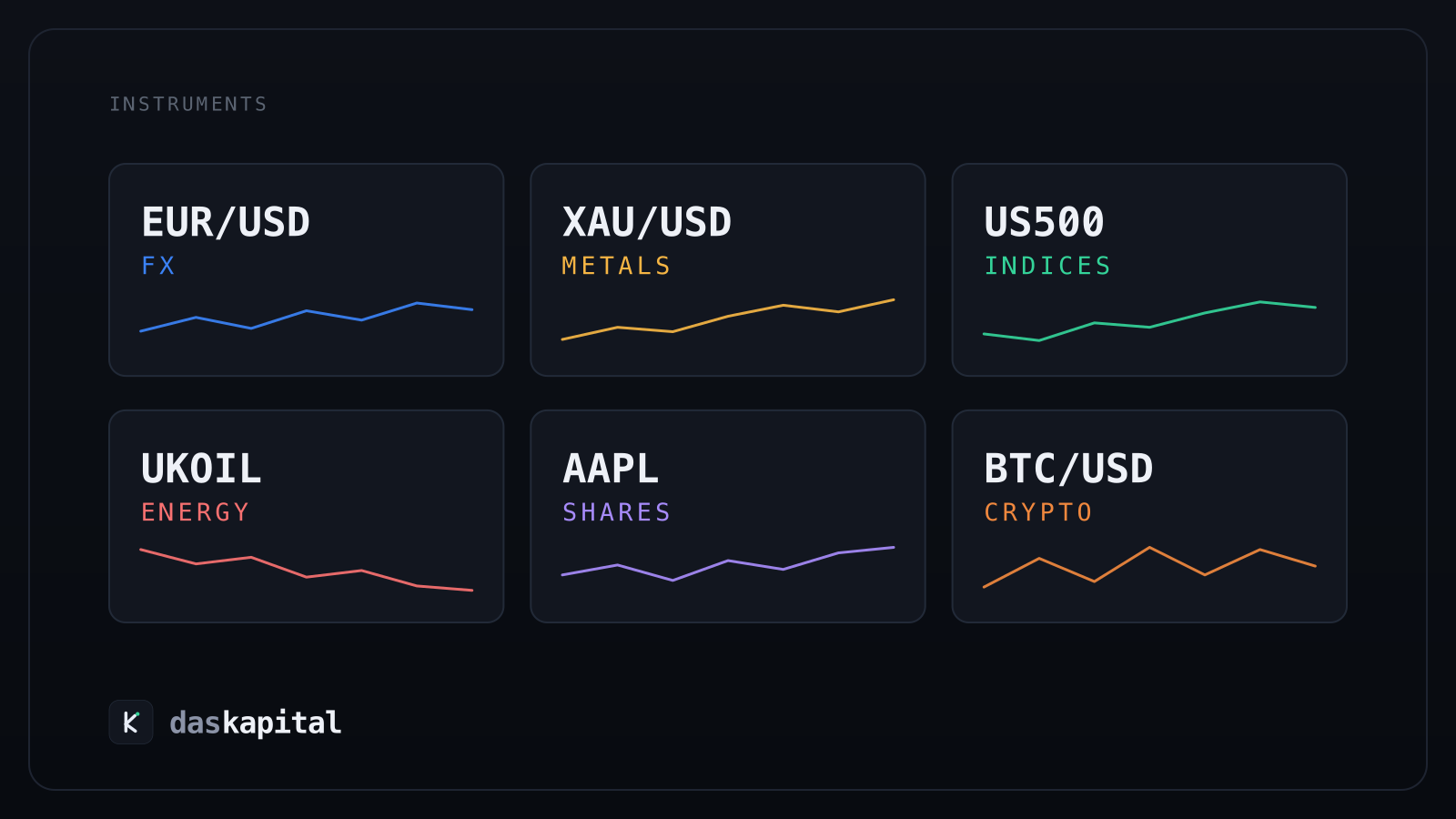
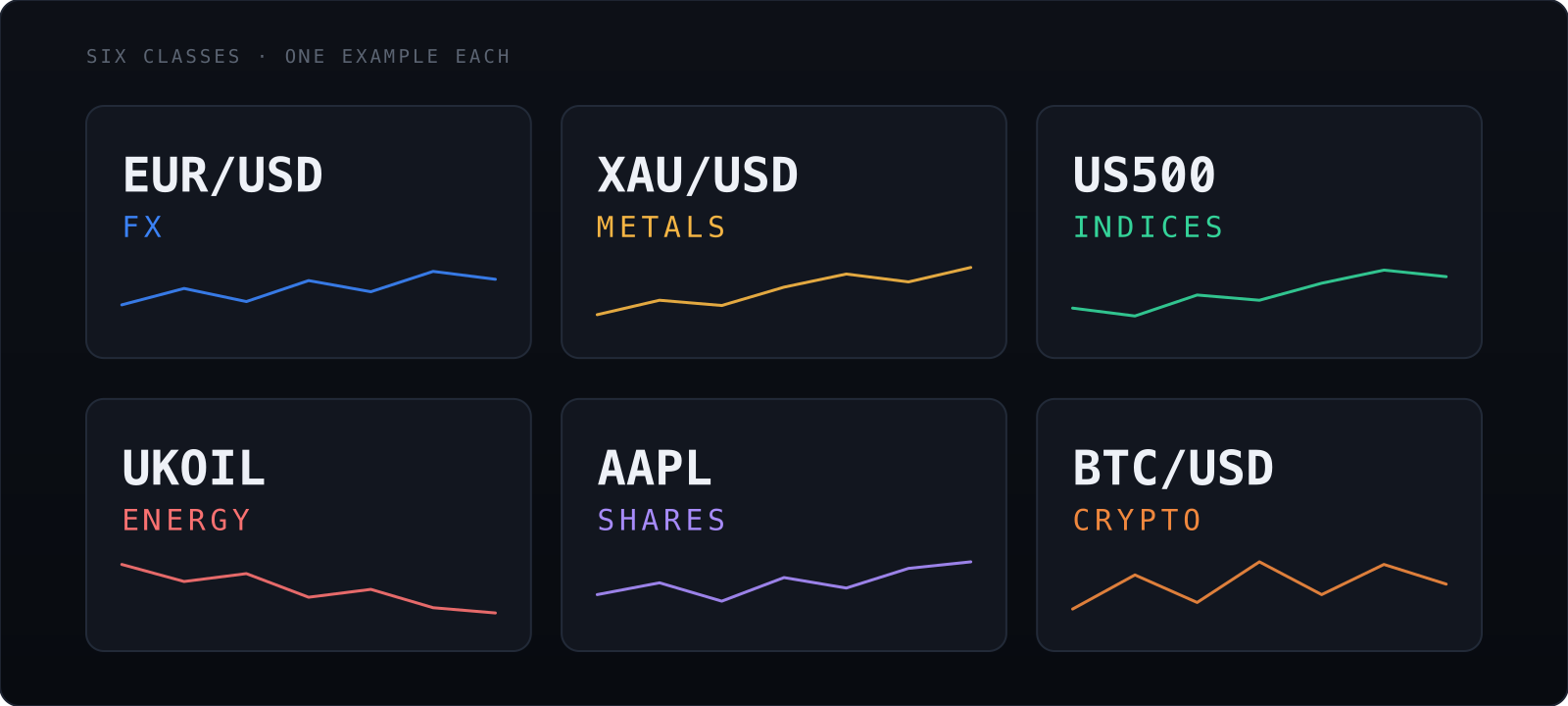
A retail trading account will happily show you several thousand instruments, sorted alphabetically, with no indication that they behave nothing like one another. They fall into six families. Knowing which family you are in tells you what moves the price, when it moves, and — the part that decides your risk — how much money one point of movement is.
Currencies
The price of one currency in terms of another, always quoted as a pair. EUR/USD at 1.0842 means one euro costs 1.0842 dollars. The majors — the seven pairs involving the dollar and a large economy — carry most of the volume and the tightest spreads. Minors pair two majors without the dollar. Exotics pair a major with a smaller economy, and cost several times more to trade for the privilege.
What moves them: interest-rate expectations above all, then inflation and employment releases, then trade and political shocks. They trade continuously from Sunday evening to Friday evening and are the deepest, cheapest market a retail account can reach.
Metals
XAU/USD is gold, priced in dollars per troy ounce; XAG/USD is silver. One standard contract is 100 ounces, so a single dollar of movement in the gold price is $100 on one lot — ten times the sensitivity of a standard FX lot, at a similar-looking screen price. This is the single most common way a new trader accidentally opens a position ten times larger than intended.
Gold moves on real interest rates, the dollar, and on fear. It has long, quiet stretches and violent ones, and the violent ones do not wait for a session to open.
Indices
A number standing for a basket of shares: US500 for the largest US companies, GER40 for Germany, UK100 for Britain, JP225 for Japan. You are trading the level, not the constituents.
Two versions exist and they are not interchangeable. A cash index tracks the market's own hours and adjusts your account when constituents pay dividends. An index future trades nearly around the clock, prices the dividends in already, and expires — which means it rolls to a new contract on a schedule you should know before you hold one overnight.
Energy
UKOIL (Brent) and USOIL (WTI) are crude oil, quoted in dollars per barrel with a standard contract of 1,000 barrels — so a dollar of movement is $1,000 on one lot. They are futures underneath, so they expire and roll, and the price can gap between the old contract and the new one for reasons that have nothing to do with the market's direction.
They move on supply decisions, inventory reports, and geopolitics, and they are among the most volatile instruments a retail account offers.
Shares
AAPL, and a few thousand others. On most retail platforms you are not buying the share: you are trading a contract whose value follows it. That contract gives you the price movement and the dividend adjustment, and gives you no vote, no certificate and no claim on the company.
Single shares move on earnings — quarterly, scheduled, and frequently by more overnight than in the preceding month. A share that closed at 190 can open at 172, straight through anything you had resting in between. That gap risk is the defining feature of the class, not an edge case.
Crypto
BTC/USD and its neighbours are the only class that never closes, which sounds like an advantage and is mostly a warning: the widest spreads and the thinnest books arrive at the weekend, exactly when everything else is shut and there is no other market to check against.
All six, side by side
| Class | Example | One standard contract | What moves it most |
|---|---|---|---|
| Currencies | EUR/USD | 100,000 units of the base currency | Interest-rate expectations |
| Metals | XAU/USD | 100 troy ounces | Real rates, the dollar, fear |
| Indices | US500 | Index level × contract multiplier | Earnings season, rates, risk appetite |
| Energy | UKOIL | 1,000 barrels | Supply decisions, inventories, geopolitics |
| Shares | AAPL | 1 share per unit | Company earnings and guidance |
| Crypto | BTC/USD | 1 coin per unit | Flows, liquidations, sentiment |
Contract sizes are the standard retail convention, and brokers do vary at the edges — particularly on indices and crypto. Check yours in the instrument specification before sizing anything.
When each one is awake
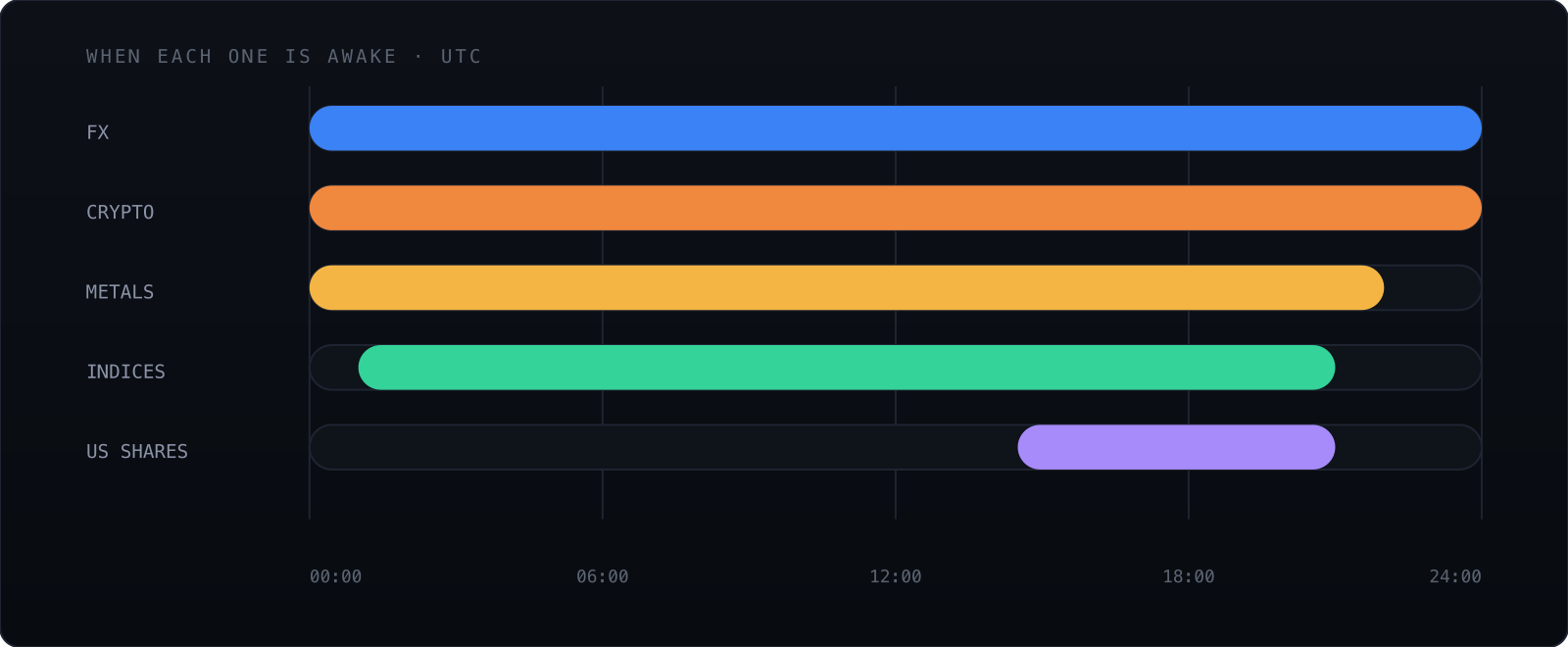
The gaps matter more than the coverage. An instrument that is closed cannot be exited, so a stop-loss on a share does nothing between the close and the next open; anything that happens in that window is settled at whatever price the market opens at.
The number that decides your risk
Before position size means anything, you need to know what one point is worth. It is always the same arithmetic: the size of one contract, multiplied by the smallest movement you are quoted.
| Instrument | One lot | Smallest quoted move | Value of that move |
|---|---|---|---|
| EUR/USD | 100,000 EUR | 0.0001 (1 pip) | $10 |
| XAU/USD | 100 oz | $0.01 | $1 |
| US500 | 1 index contract | 0.1 index point | $0.10 |
| UKOIL | 1,000 barrels | $0.01 | $10 |
| AAPL | 100 shares | $0.01 | $1 |
Work backwards from what you are willing to lose. If a trade is allowed to lose $50 and the stop sits 25 pips away on EUR/USD, then 25 × $10 = $250 per lot, so the position is 0.2 lots. The same $50 with a stop $3 away on gold is $300 per lot, so 0.17 lots. The screen prices look comparable; the positions are not.
Where to start
- One instrument, long enough to know how it behaves at each hour of the day.
- A major currency pair first: cheapest to trade, deepest book, no expiry, no dividend adjustment, no overnight gap.
- Read the instrument specification before the first trade — contract size, minimum step, trading hours, swap.
- Add a second instrument only once you can state what moves the first one.
The instrument decides the risk long before the strategy gets a say.
What each of these costs to trade is what a spread actually costs you, and who quotes them to you is what a broker actually does.