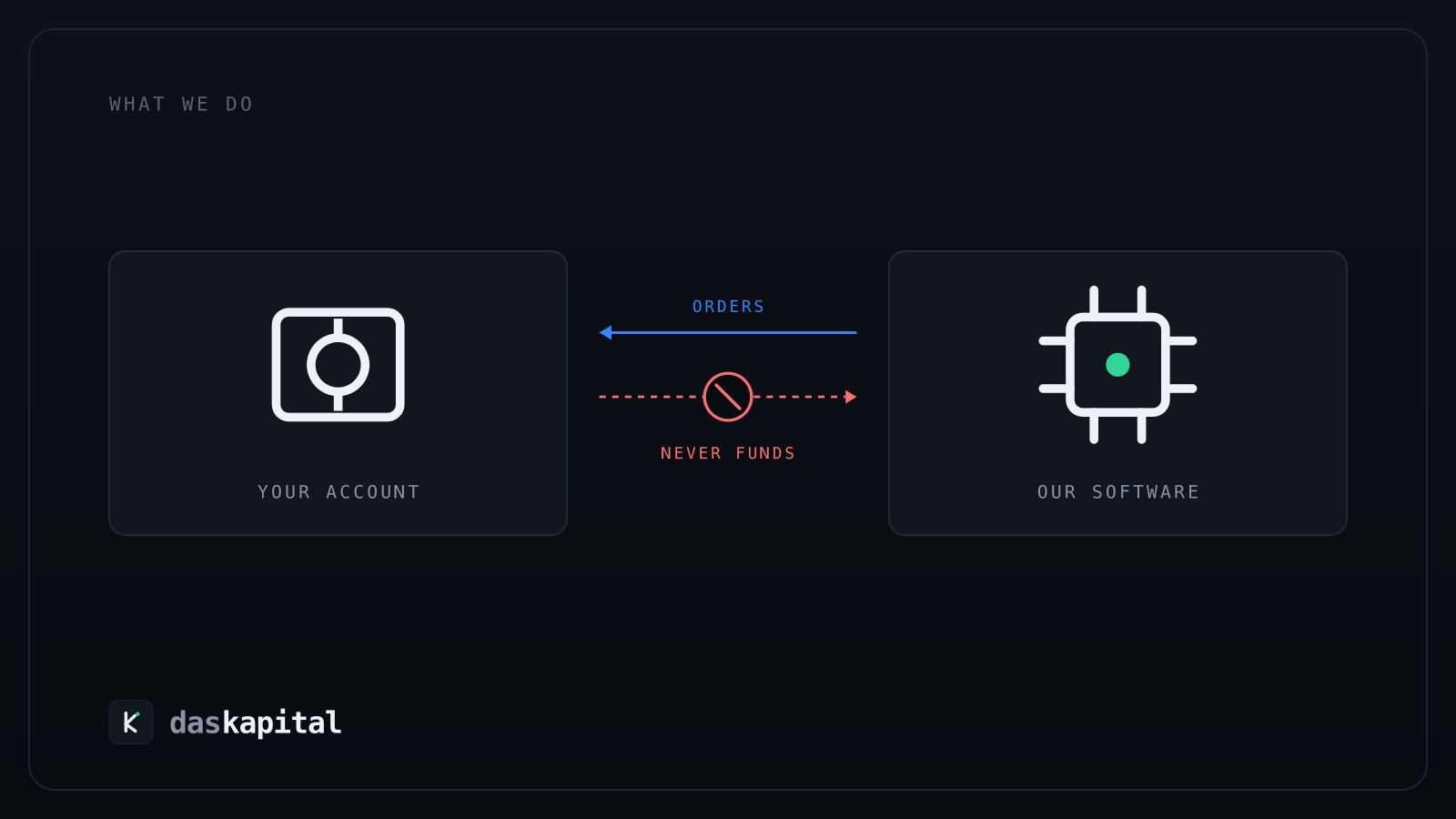
daskapital runs a trading bot on an account you already own at a broker you already chose. You set how much risk it may take. It watches the market continuously and places trades within that limit. You keep your money where it is.
That last sentence is the whole design, and everything below is a consequence of it.
Your account stays yours
You connect your broker account by granting a revocable, trade-only authorisation. It lets the bot read your balance and place orders. It does not permit withdrawals — not as a policy we promise to keep, but because the permission to move money is simply not part of what you granted. You can revoke it from your broker in seconds, at any time, without telling us.
We never hold your funds, and there is no daskapital wallet to transfer anything into.
You set the risk, and the server enforces it
Two numbers: how much of the account a single trade may put at risk, and how many trades may be open at once. Both are enforced on our servers rather than in your browser, so closing the tab, losing your connection, or editing anything on the page changes nothing about what the bot is allowed to do.
The two interact, deliberately. Raising the risk per trade lowers the number of positions the bot may hold at the same time, so the account's total exposure cannot be multiplied by opening more of them.
Every trade carries a stop-loss
The stop is placed at your broker together with the order, not held in our software and sent later. It protects the position through our outages as well as yours — if we disappear entirely, the stop is still sitting at the broker.
It is not a guarantee. A stop is an instruction to exit at the market once a price is reached, and in a gap — a weekend, an earnings release, a shock — the market's next price can be well past it. That is a property of markets, not of the software.
Drawdown breakers sit above the individual stops: if losses accumulate, trading halts by itself and open positions are managed to a close rather than left running.
Demo first, and going live takes two deliberate acts
A trial runs on practice funds against real market conditions — the same bot, the same instruments, the same costs, no real money. Moving to live is not a toggle: it requires two separate, deliberate confirmations, and the second asks you to type. The slowness is the feature.
What you can see
- Equity over time, with the drawdowns shown next to the gains rather than cropped out.
- Every trade, with its entry, its exit, and the reason it exited.
- A full export, so the record is yours and not only visible inside our interface.
- The state of the bot and its connection, live.
What we do not publish, in the dashboard or anywhere else, is how the strategy decides. That is deliberate and it is not going to change: a strategy that is public is a strategy that is being traded against.
What it costs
| Plan | Price | What it is |
|---|---|---|
| Demo | $1 per bot, 14 days | Practice funds, real conditions. One payment, nothing renews. |
| Live | $49 per bot per month | One bot trades one broker account. Cancel per bot, one click. |
No tiers and nothing withheld for a larger plan. Adding a second broker account means a second bot at the same price — the cost multiplies rather than stepping up.
What it is not
- Not financial advice. Nothing we publish is a recommendation about your circumstances, and we are not licensed to give one.
- Not a guarantee. Losses are possible at any time. Past results, ours included, say nothing certain about future ones.
- Not a managed fund. We never take custody. You are trading your own account under your own name.
- Not a signal service. There is nothing to copy manually and no group to join.
- Not a substitute for understanding the costs. The bot pays the same spreads and commissions you would.
Your account, your funds, your risk setting. Software that can trade and cannot withdraw.
If you have not yet chosen a broker, start with what a broker actually does and the broker comparison. If you have, the number worth knowing before anything else is what a spread actually costs you. The full terms and the risk disclosure are on the legal pages.